Understanding the Balance Between Science and Experience
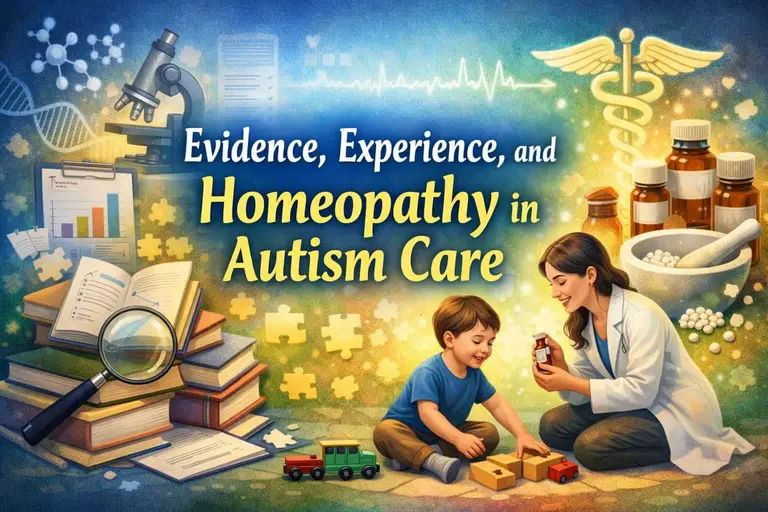
When parents explore treatment options for autism, they often hear many different opinions. Some are based on scientific research, some on clinical experience, and some on personal stories of improvement. To make the best decision for your child, it is important to understand both what research says and what doctors and families experience in real life.
🔬 What Research Says
Some case studies published in homeopathy journals describe possible improvement in autism-related symptoms such as behavior, attention, sleep, social response, and emotional balance after long-term individualized homeopathic treatment. These reports are usually based on detailed observation of one or a small group of children over many months.
However, these studies are limited in number. Most are not large, randomized, or strictly controlled. Because of this, they cannot be considered final scientific proof. In simple words, they show what may be possible in some individual cases, but they do not prove that homeopathy works the same way for every child with autism.
📊 What Big Reviews Say
When large scientific organizations and independent researchers review all available studies together, they find that there is very limited high-quality research on homeopathy in autism. Most of the existing studies are small, have weak design, or lack proper comparison groups.
Because of this, most experts agree that strong scientific evidence is still missing. This does not mean that no child can benefit, but it means that science has not yet confirmed homeopathy as a proven treatment for core autism symptoms in the same way some developmental and behavioral approaches are supported.
👩⚕️ Expert Opinion
Most pediatric and developmental experts agree that evidence-based developmental care remains the main approach for autism. These methods are supported by strong research for improving communication, learning skills, and daily functioning.
At the same time, many families look for gentle and natural options to support their child’s overall well-being. Homeopathy is often chosen because it is natural, gentle, and generally safe when prescribed correctly. Many doctors practicing homeopathy focus on the child as a whole—mind, body, emotions, sleep, digestion, and immunity—rather than only on one symptom.
Experts suggest that if parents choose homeopathy, it should be done with proper medical guidance and realistic expectations, and not in isolation from overall developmental care.
📌 What Parents Often Experience
Many parents who try homeopathy for their child share experiences such as:
• Better sleep and calmer behavior
• Improved digestion or appetite
• Better emotional stability
• Gradual improvement in attention or interaction
At the same time, not every child shows the same level of change. Autism is very individual, and response to any treatment—whether medical, developmental, or complementary—can vary from child to child.
📌 Putting It All Together for Parents
- ✔️ Homeopathy is gentle and generally safe when used correctly under medical guidance.
- ✔️ Some families report positive changes over months of individualized treatment.
- ❗ Strong scientific proof is still limited, and most studies are small or not well controlled.
- ✔️ Homeopathy should be used as a supportive option, not as a replacement for standard developmental and medical care.